GNSS holdover is the state in which a timing system continues producing time without a usable external reference, using its local oscillator and stored estimates. Its useful duration ends when the output can no longer meet the application’s time-error requirement. “Still producing 1PPS” is not the same as remaining within that requirement.
Do not choose holdover from oscillator names alone. An OCXO, rubidium oscillator or cesium reference does not carry a universal number of acceptable hours or days. Initial synchronization, frequency offset, temperature, aging and the clock’s control algorithm all affect the result.
Define a GNSS holdover budget before buying hardware
Start at the downstream interface: what time error is acceptable, for how long, and under which failure conditions? Allocate part of that budget to the error already present when holdover begins. Include distribution and measurement uncertainty as well as the source clock.
For a simple illustration of frequency error, time error accumulates with the integral of fractional frequency offset. Even a constant offset consumes the budget with elapsed time. Real oscillators also have changing environmental and aging effects, so a straight-line projection is not a complete qualification.
ITU-T G.8272.1 specifies enhanced primary reference time-clock characteristics, including holdover behavior under defined conditions. An ePRTC is a system-level designation; it is not a synonym for any cesium oscillator. Check the applicable edition and equipment evidence rather than assigning the recommendation’s limits to a component.
Loss, degradation and false time require different responses
A cable fault or obstruction may cause loss of reception. Interference can degrade measurements before the receiver declares loss of lock. Counterfeit signals may instead produce plausible but incorrect time. An outage detector based only on satellite count will not cover all three cases.
The system needs a policy for deciding whether a reference is usable. Depending on the equipment, this can include signal-quality monitoring, comparison with an independent source, consistency checks and limits on time or frequency changes. Detection capability must be verified for the failure modes you expect.
Holdover can help after the system rejects an untrusted reference. It does not automatically protect against incorrect time that the clock continues accepting. The GNSS jamming and spoofing comparison provides background on that distinction.
Compare oscillator evidence using the same conditions
| Procurement question | Why it matters |
|---|---|
| What is the allowed time error at holdover entry? | Existing offset reduces the remaining margin |
| How long was the clock disciplined before the test? | Learning and settling affect the stored estimates |
| Which temperature profile was used? | A constant-temperature result may not fit a field cabinet |
| What aging and calibration assumptions apply? | A new-sample result may not describe later service |
| Is the result guaranteed, typical or measured on one unit? | The evidence supports different procurement conclusions |
| How does recovery steer the output? | Reacquisition can introduce unacceptable time steps |
Compare time-error curves against the same budget, not a headline duration with an unspecified limit. Ask for the full equipment configuration, including firmware and oscillator option.
Reduce avoidable outages at the antenna
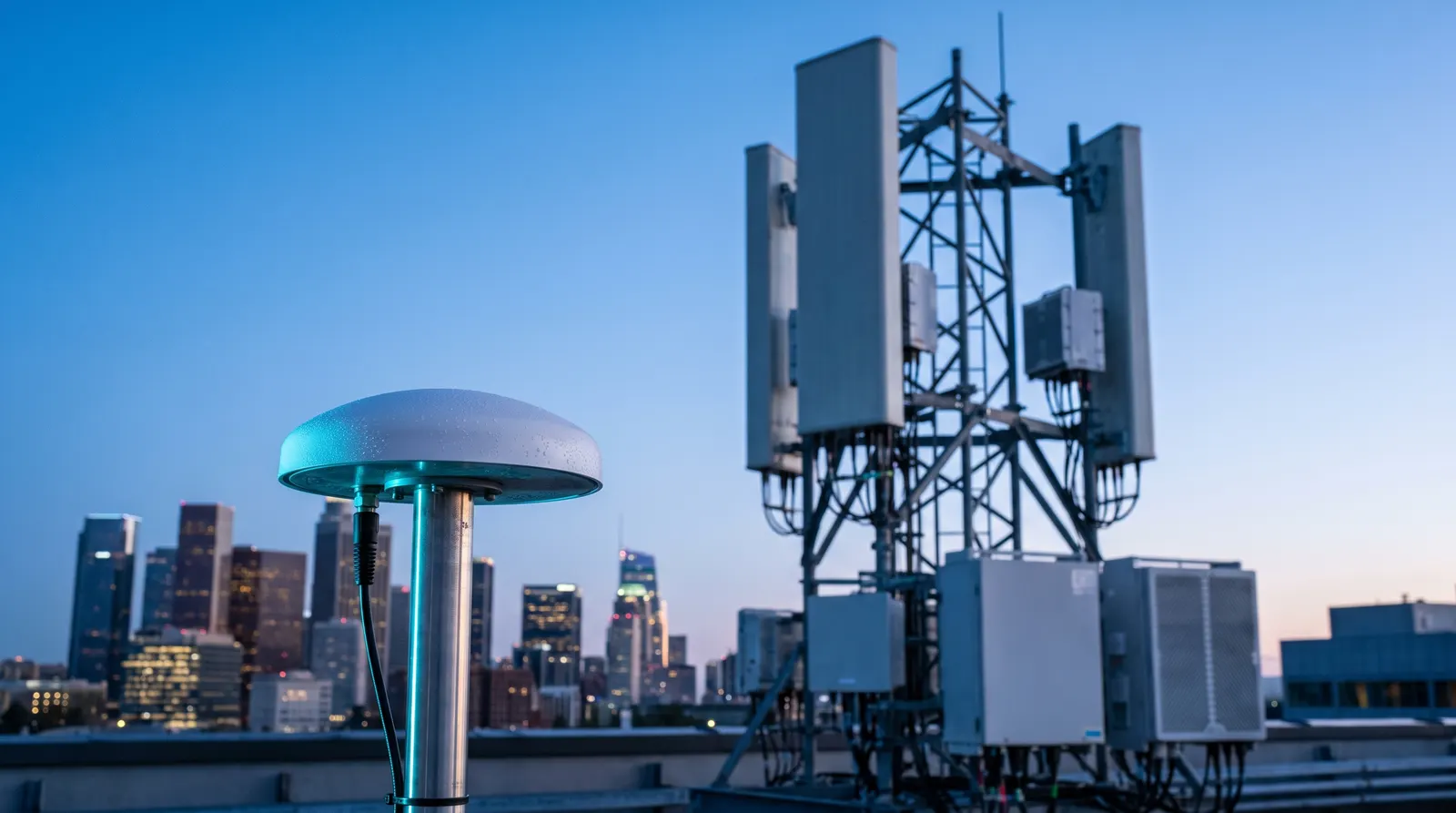
A well-sited receiving antenna can reduce obstruction and some interference problems. Match its bands, supply, gain and cable to the timing receiver. Inspect the installed connector seal and cable route, especially after roof work or changes to nearby transmitters.
Multi-constellation reception can improve available observations, but does not make RF paths independent. Constellations can share spectrum, and the same antenna, amplifier or cable fault can affect them together. Passive filtering can help with out-of-band energy; it cannot guarantee rejection of an interfering or counterfeit signal inside the passband.
Use the GNSS timing antenna guide to review the front end. Once reception is lost, oscillator and control behavior determine holdover; the antenna does not set its duration.
Backup timing needs failure independence
A network-delivered source can support continuity, but inspect its origin. A PTP path and a local GNSS receiver may depend on the same upstream satellite reference or common power supply. Different interfaces do not necessarily mean independent failure modes.
Document upstream references, route diversity, power, alarm delivery and switching behavior. Include network asymmetry and distribution error in the backup budget. NTP, PTP and fiber delivery describe mechanisms, not interchangeable accuracy guarantees.
For critical civil infrastructure, define when downstream consumers should mark time invalid or enter their own fallback state. Continuing to distribute an unqualified timestamp can be worse than exposing the loss of confidence.
Test entry, duration and recovery
Use an independent reference whose uncertainty is suitable for the budget. Measure normal locked operation, remove or invalidate the input through an approved test method, and record output time error throughout the intended holdover period. Include temperature and other operating conditions in the log.
Mark alarm transitions, reference selection and time-quality flags. Confirm that downstream consumers receive those states. Repeat recovery with the reference restored and examine whether the output steps or slews, how long it takes to settle, and whether stale status persists.
A trial that disconnects one antenna tests reference loss. It does not test detection of false time or prove diversity of another source. Keep these acceptance cases separate.
Frequently asked questions
How long can an OCXO hold time without GNSS? The answer needs an error limit and operating conditions. Use equipment-specific test evidence rather than a universal duration.
Does a better antenna replace holdover? No. It may reduce some outages, but cannot keep the clock synchronized after a complete loss of usable references.
Is PTP always an independent backup? No. Trace its upstream reference, network route and power dependencies before assigning resilience credit.
When reviewing the receiving hardware, compare timing and synchronization antenna options and share your receiver, cable, rooftop environment and monitoring needs with GNSource. Specify holdover performance and reference-switching behavior separately with the clock supplier.