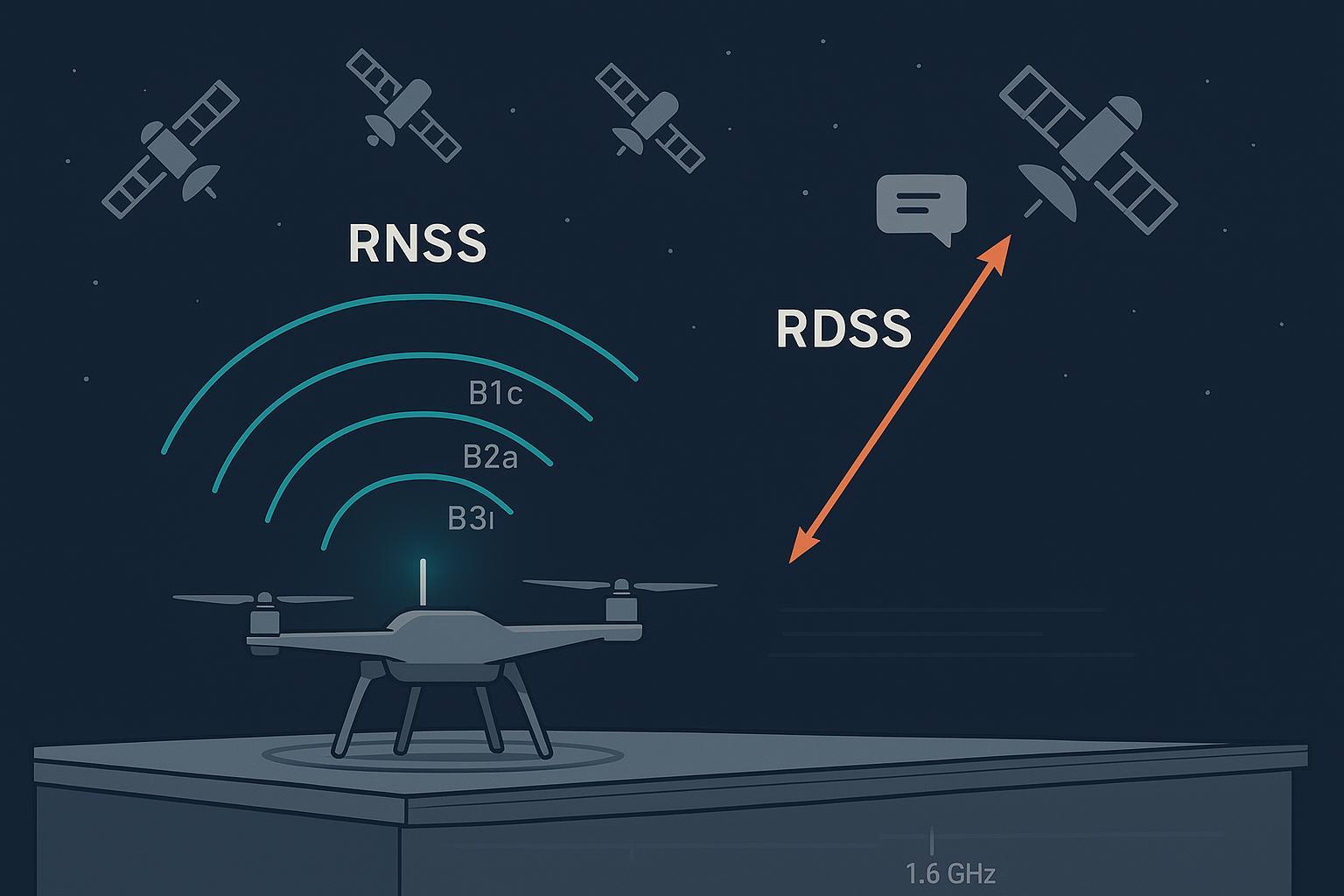
BeiDou GNSS antennas should be selected by the signals and services your equipment uses. A multi-band receiving antenna can support BeiDou positioning alongside other constellations. Short-message communication adds a transmit requirement; it is a different hardware task. Neither a BeiDou label nor broad frequency coverage proves that an antenna supports every service.
For civil surveying, reference stations and agricultural equipment, start with the receiver’s RNSS signal list. Add messaging hardware only when the project requires it.
BeiDou GNSS antenna bands: check signal names
Use the signal names in the receiver’s documentation when comparing antennas. The same broad band label can conceal different signal selections.
| Signal | Selection question |
|---|---|
| B1I | Does the receiver track this signal? |
| B1C | Is the specified passband wide enough for the signal? |
| B2a | Does the antenna explicitly include this lower-band signal? |
| B2b | Which ranging or correction service will the receiver decode? |
| B3I | Is it included in both receiver and antenna documentation? |
Frequency overlap with other GNSS signals can help antenna integration, but it does not prove adequate bandwidth, polarization performance or receiver decoding support. Avoid reducing a specification to “B1/B2/B3”: name the signals.
RNSS receives; messaging also transmits
RNSS positioning uses signals received from satellites. An active RNSS antenna needs DC power for its amplifier, but “active” does not mean it transmits. The receiver computes position using the observations it tracks.
BeiDou short-message terminals include a transmit chain and service-specific receive paths. Regional and global short-message services have different architectures. Lu, Guo and Su’s primary paper on BDS capabilities (2020) distinguishes them from RNSS and the regional PPP service. Do not apply one service’s antenna layout, coverage or message capacity to the other.
For a regional RNSS/RDSS terminal, specify the uplink and downlink bands, transmit power, antenna isolation and terminal interface together. Check service access with the terminal supplier. A receive-only survey antenna cannot acquire messaging capability through a receiver setting.
PPP-B2b needs more than B2b reception
PPP-B2b carries precise corrections for a compatible positioning receiver. Receiving the band is a prerequisite, not a positioning-accuracy specification. The receiver must decode the correction messages, apply them to supported observations and operate within the service area. Convergence and the local environment still matter.
For a remote monitoring or survey project, ask the receiver supplier to confirm PPP-B2b support explicitly. Record the intended operating region and the behavior during correction loss. Do not assume the service has the same coverage as BeiDou’s global positioning signals.
Match a civil measurement antenna to the receiver
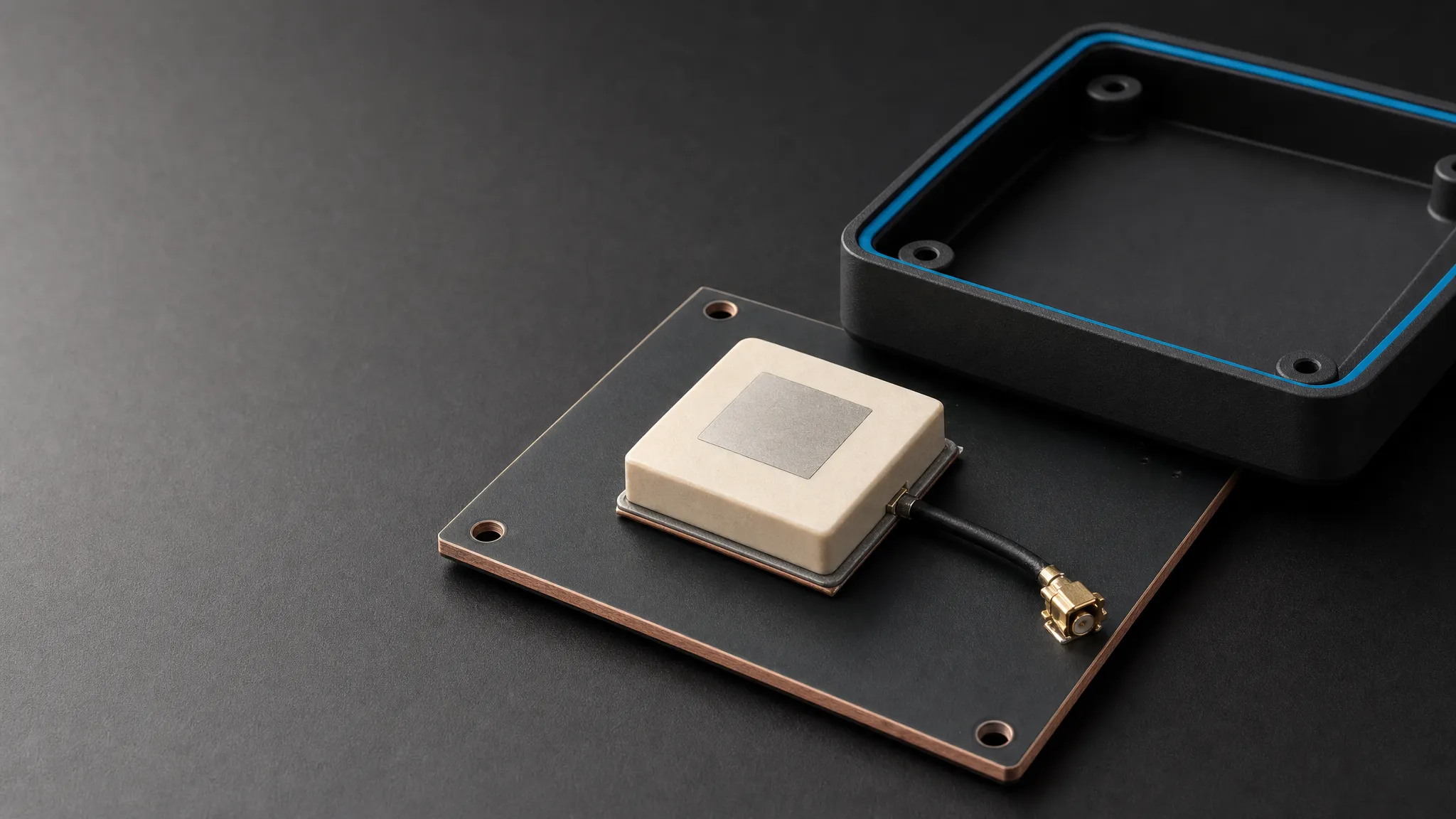
GNSource’s high-precision measurement models have different signal lists. For example, TDXL-BA600 lists B1I/B1C/B2a/B2b/B3I, while TDXL-BA720 lists B1I/B1C/B2b/B3I and does not list B2a. That distinction matters when your receiver uses B2a. Neither listing makes these receiving models RDSS transmit antennas.
After checking signals, review the active antenna’s supply range, current draw, gain and connector against the receiver and cable assembly. For carrier-phase work, request the relevant phase-center information and check whether your workflow requires an antenna calibration. The high-precision antenna selection guide explains the remaining installation questions.
A useful qualification sequence
- Freeze the receiver model, firmware and enabled signals before comparing antennas.
- Verify each required band with the supplier’s current model-specific documentation.
- Check supply voltage at the antenna under load and the receiver’s permitted antenna gain range.
- Log per-signal tracking quality, observation continuity and correction status with the production mount and cable.
- If messaging is included, repeat reception checks while the terminal transmits in an authorized test setup. Investigate desensitization and recovery rather than assuming the integrated package provides enough isolation.
Keep performance conclusions tied to that configuration. A clear-sky receive test does not establish messaging coexistence, and a successful message does not validate survey measurements.
Frequently asked questions
Will any multi-band GNSS antenna receive BeiDou? Check the signal list and passband. “Multi-band” describes a class, not a complete signal guarantee.
Does an active antenna send messages? No. In a GNSS receiving antenna, active normally refers to the powered amplifier. Messaging needs a compatible transmit antenna path and terminal.
Does B2b coverage guarantee PPP accuracy? No. Antenna coverage, receiver processing, correction availability and field conditions must all match the job.
For a model shortlist, send GNSource your receiver, required BeiDou signals, cable and mounting requirements. Include any messaging requirement separately so the RF paths can be reviewed together.