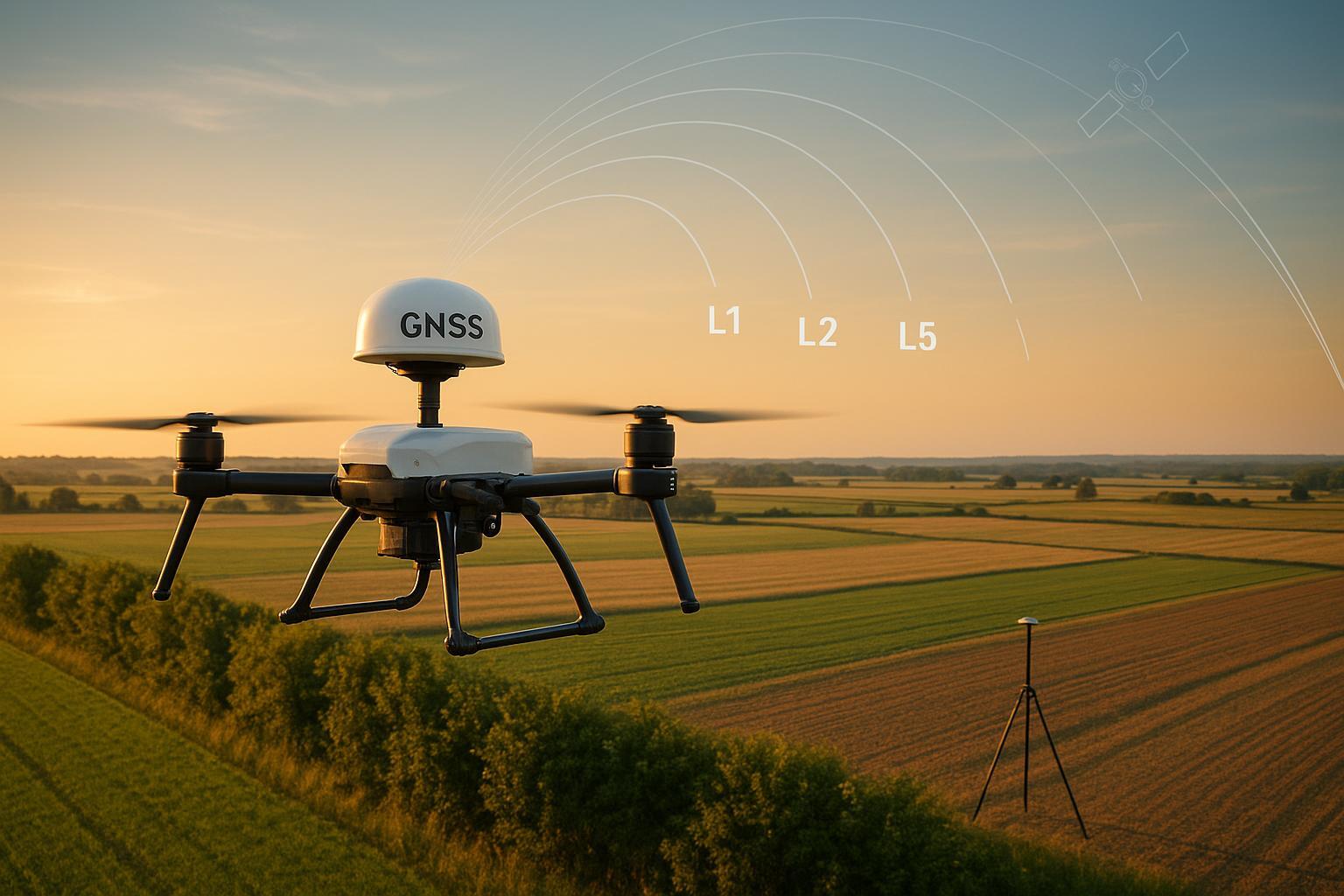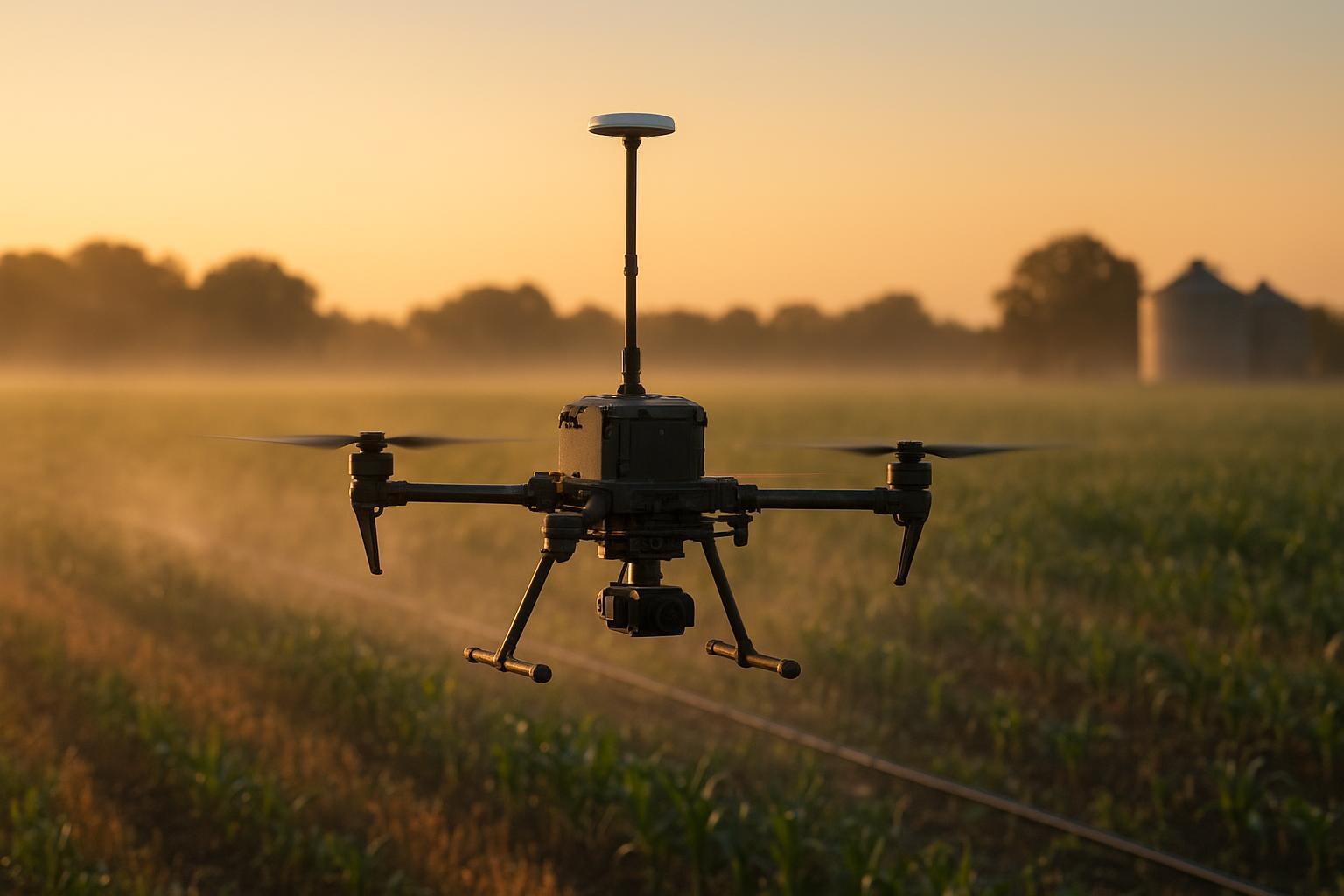
GNSS antennas for precision agriculture need to support repeatable measurements on the installed machine. On a tractor, this means accounting for cab movement and the guidance reference point. On a mapping or spraying UAV, it includes airframe attitude, nearby radios and the relationship between the antenna and payload. The antenna is one part of that system; it cannot guarantee a crop-row accuracy or RTK fixed percentage on its own.
Begin with the agricultural task: guidance, repeat-pass work, mapping or payload georeferencing. Define how the result will be checked before selecting hardware.
Selecting GNSS antennas for precision agriculture
Match antenna signals to the receiver and the correction workflow. “Multi-band” is insufficient when the receiver needs a specific signal that the antenna omits. Also check active or passive operation, bias voltage, current, connector and receiver gain limits after the complete cable loss.
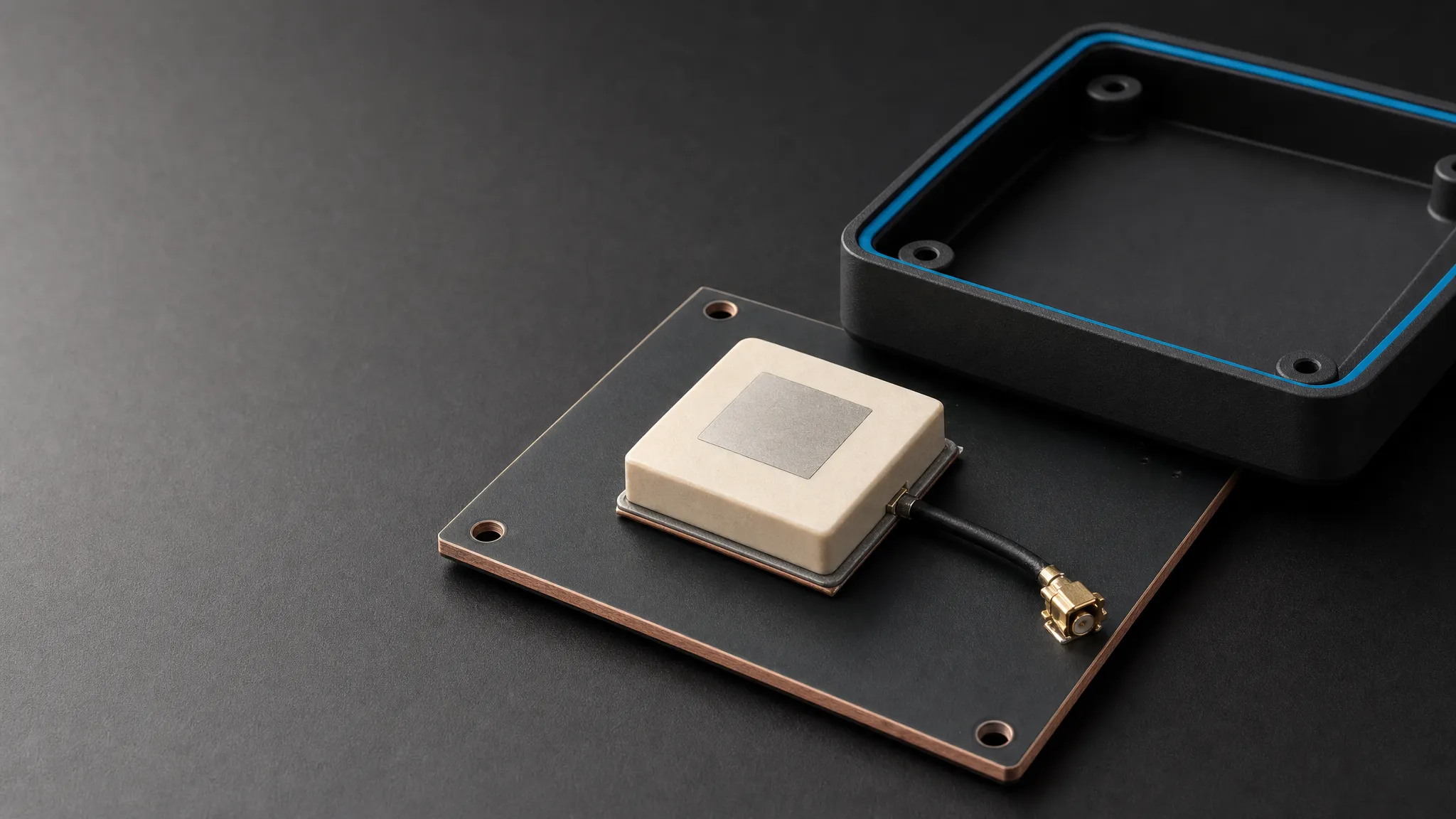
For civil field equipment, GNSource’s measurement antenna range includes models with different signal selections and mechanical interfaces. Use those model-specific lists for screening; a catalog-level description does not establish the final system’s positioning performance.
Ask how phase-center behavior is documented if your mapping or reference workflow uses antenna corrections. The NGS calibration database associates calibrations with antenna and radome codes. A generic phase-center error figure is not a substitute for a compatible calibration file when your processing requires one.
Mounting geometry is part of the measurement
On a vehicle, secure the antenna to a stiff structure and measure its offset from the guidance reference point. Confirm how the guidance controller handles roll, pitch and antenna height. An antenna mounted high above the vehicle reference point can move laterally when the machine tilts, even while the GNSS solution itself remains consistent.
On a UAV, keep the antenna’s sky view clear in the expected attitudes. Document offsets to the camera, inertial sensor or application reference point and check event timing for georeferencing. Moving the antenna or changing the mount requires review of those offsets.
Follow the antenna’s ground-plane requirements. Do not assume a carbon-fiber panel behaves like the metal reference plane used for a datasheet measurement. Test with the production enclosure, bracket and payload rather than relying on a bare receiver bench result.
Keep RF and correction faults distinguishable
Route the GNSS cable away from noisy electronics and support it so vibration does not load the connector. Use the required sealed mated interface and cable bend radius. For agricultural exposure, the farm-equipment durability guide covers cleaning, chemicals and service inspections.
Test ordinary radio and payload operating states while logging GNSS observations. If quality changes with a transmitter or motor state, investigate that correlation before altering receiver settings. Additional filtering or shielding needs validation because it can change the RF budget.
RTK also needs usable correction data. NovAtel’s explanation of GNSS corrections describes constraints including base-station setup, obstructions and environmental conditions. An antenna change cannot repair a broken NTRIP connection or incorrect reference coordinates.
Build a field test around the farm task
Use representative routes and sky conditions. Include the turns, canopy edges or headlands that matter to the machine, while keeping the operation within its approved envelope. Repeat comparable passes with the same receiver settings and correction source.
| Record | Why it matters | Comparison rule |
|---|---|---|
| Raw observations and loss-of-lock flags | Identify measurement interruptions | Compare like signals and geometry |
| RTK state and correction age | Separate measurement and data-link problems | Mark correction outages explicitly |
| C/N0 by signal and elevation | Identify affected bands or sky sectors | Avoid comparing unmatched averages |
| Error against independent control | Check the delivered positioning result | State reference uncertainty and frame |
| Attitude and machine events | Relate faults to turns, payload or vibration | Synchronize event timestamps |
If comparing antennas, change the antenna first while holding the other variables fixed. A later mount or cable change is a separate comparison. Changing several things together can improve the system, but it does not reveal which change helped.
Set acceptance limits from the guidance or mapping requirement. Define recovery behavior after an interruption as well as ordinary accuracy. A high fixed fraction can conceal a biased position, and a good average can conceal a bad headland turn. Inspect the event-level results.
Avoid compensating for a poor installation in settings
Elevation masks and observation weighting trade measurement quality against satellite geometry. Follow receiver guidance and document any changes. Raising a mask indiscriminately can remove useful observations without resolving the cause of poor ones.
Keep firmware, antenna descriptors, coordinate frames and reference coordinates controlled during comparison. For repeat-pass agriculture, document how the reference is re-established between days. A change in base coordinates can appear as a shifted guidance line even when the RF hardware is unchanged.
Frequently asked questions
Does a multi-band antenna guarantee RTK fixed operation? No. It must match the receiver, while corrections, sky conditions and installation remain suitable.
Can RTK fixed status verify a mapping deliverable? It is useful diagnostic evidence. Check the result against independent control and confirm the georeferencing offsets and timing.
Should I use the same mount on a tractor and a UAV? Only if it meets both installations’ mechanical, RF and measurement needs. Their attitude and payload constraints differ.
For an agricultural sample evaluation, share your receiver, required signals, machine or UAV, cable and mount with GNSource. Include the field acceptance task so the shortlist can be evaluated against the actual workflow.