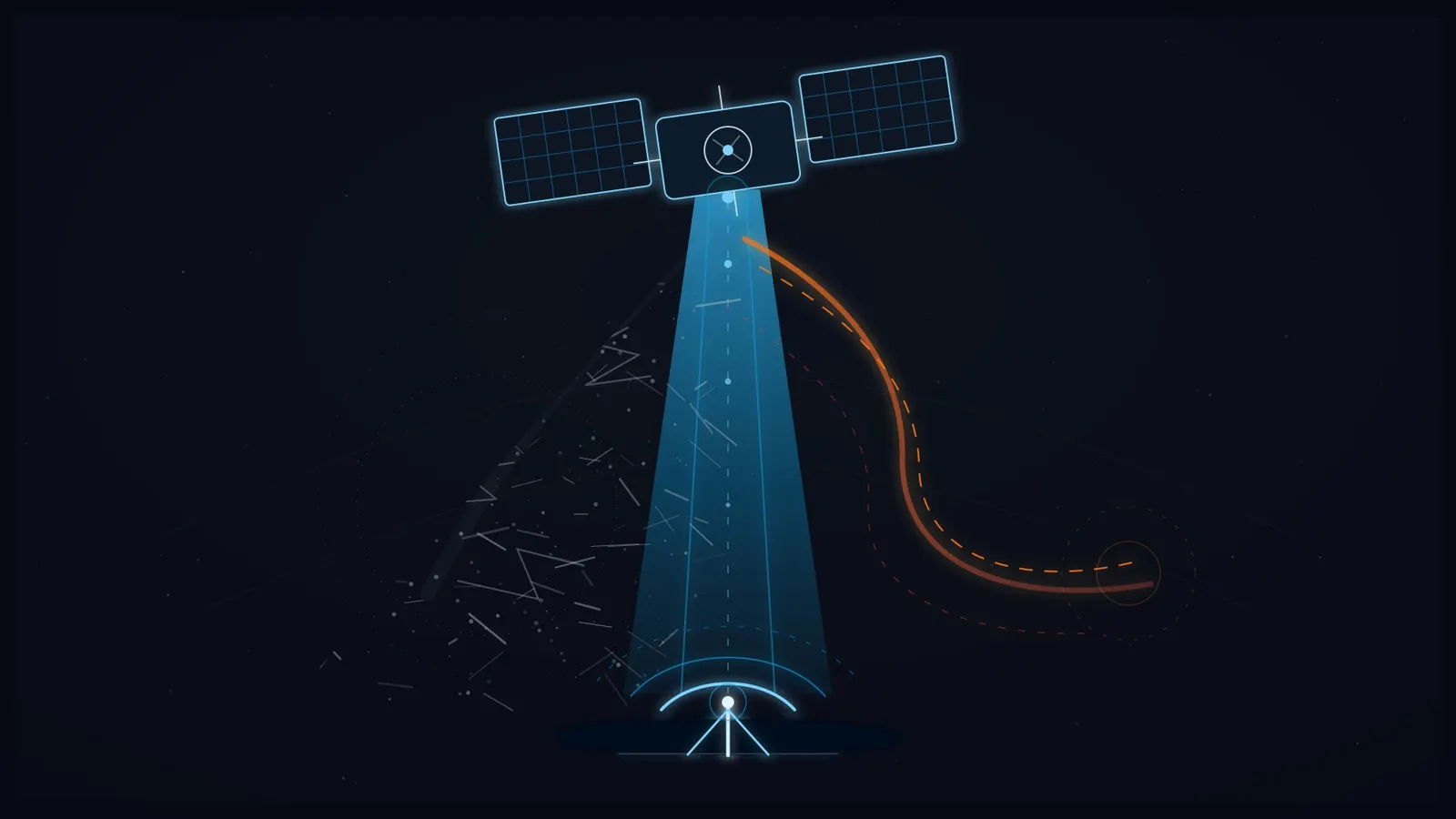
GNSS jamming vs spoofing is a distinction between interference that disrupts reception and false signals that can mislead a receiver. The symptoms overlap. Jamming does not always produce an obvious loss of position, and spoofing does not always leave a receiver reporting a plausible fix.
For civilian surveying, mapping and timing, the practical task is to recognize unreliable GNSS output, preserve useful logs and follow an application-specific fallback procedure. A single signal-strength reading or solution-status flag cannot establish the cause.
GNSS jamming vs spoofing at a glance
| Question | Jamming | Spoofing |
|---|---|---|
| What happens at the receiver? | Unwanted RF energy interferes with reception or tracking | False or rebroadcast signals may influence the observations |
| What might the operator see? | Degraded tracking, interruptions, noisy output or loss of service | Inconsistent position, velocity or time; possible alarms or tracking loss |
| What evidence helps? | RF monitor data, signal changes and correlation with operating conditions | Observation consistency, authentication status and independent reference data |
| What can mitigation address? | Some spectral or spatial interference conditions | Certain false-signal mechanisms, with receiver and system-level checks |
These are mechanisms and possible symptoms, not a field diagnosis chart. Blockage, multipath, a damaged cable, power noise or an interrupted correction stream can also degrade an RTK workflow. Establish those ordinary causes before labeling an event.
Jamming may degrade service before it disappears
Interference can affect only part of the tracked signal set or drive a front end into nonlinear behavior. A receiver may continue to output positions while uncertainty or tracking quality changes. Some systems also continue using previous data or other sensors when GNSS becomes unreliable, so “a coordinate is still present” does not mean reception is healthy.
An active antenna’s filter and amplifier matter here. Filtering outside the wanted bands may reduce some blockers, but an ordinary bandpass filter cannot separate unwanted energy from a desired signal at the same frequency. The u-blox discussion of RF interference in GNSS distinguishes front-end overload and interference mechanisms. Apply that distinction when diagnosing the antenna-to-receiver chain.
If degradation coincides with an onboard radio, motor controller or computer load, investigate self-generated emissions. Our GNSS EMI diagnostic workflow explains how to isolate those operating states without assuming an external emitter.
Spoofing can affect position, velocity or time
A receiver estimates navigation and timing from received observations and navigation data. Signals that imitate or rebroadcast GNSS can disturb that process. Depending on the event and the receiver, the result may be a gradual bias, a jump, a timing inconsistency, rejected measurements or lost tracking.
A plausible solution deserves independent checks when its consequences matter. Compare it with surveyed control, trusted timing, inertial measurements or another suitable reference. Two nearby receivers are useful diagnostic instruments, but agreement between them is not necessarily independent evidence: they may share the same RF exposure, corrections or implementation weaknesses.
The severity of either failure mode depends on the application. A silent position error can invalidate survey deliverables; an obvious outage can also have serious consequences if the system lacks a usable fallback. Design around both wrong output and unavailable output.
Authentication has a defined scope
Galileo OSNMA, as described by the European GNSS Service Centre, authenticates Galileo navigation-message data. A receiver must implement the required processing and key management to use it.
That scope matters. Authenticated navigation data is not a blanket guarantee that every measured range or resulting position is correct. It does not make the RF signal immune to disruption. Confirm what the exact receiver reports, what its authentication status means and how the application responds when authentication is unavailable.
Conventional measurement-consistency checks also have limits. A set of false observations may appear mutually consistent. An alarm should be interpreted using the receiver documentation; a missing alarm should not be treated as proof of authenticity.
Can a CRPA stop either problem?
A compatible adaptive array and processor can attenuate some interference using direction-dependent reception. Performance depends on source geometry, waveform, power and calibration. A separate array connected without its required processing does not acquire this capability.
Spatial processing can also contribute to certain spoofing checks or mitigation, but it does not verify navigation-message authenticity by itself. Do not buy element count as a proxy for a complete anti-spoofing function. The GNSS antenna test-report guide helps check whether supplier evidence covers the proposed system and operating conditions.
What to record during a suspected event
Preserve UTC timestamps, receiver model and firmware, antenna and cable details, solution state, tracked signals, carrier-to-noise density, RF monitor flags and correction age. Include raw observations if available, plus the operating state of nearby electronics. Record the fallback action and any independent reference disagreement.
A useful incident note distinguishes observed facts from interpretation: “tracking dropped when the telemetry transmitter became active” is an observation; “external jamming” requires additional evidence. Avoid assigning an emitter location from the affected receiver’s position alone.
For recurring problems, reproduce normal equipment operating states and compare logs across repeated sessions. Laboratory evaluation can then target a defined mechanism instead of a vague resilience claim. Set acceptance around position and timing validity as well as availability.
For a civilian installation review, share your receiver, antenna path and event logs with GNSource. Those details help determine whether antenna compatibility, installation changes or a broader receiver-system assessment is the appropriate next step.