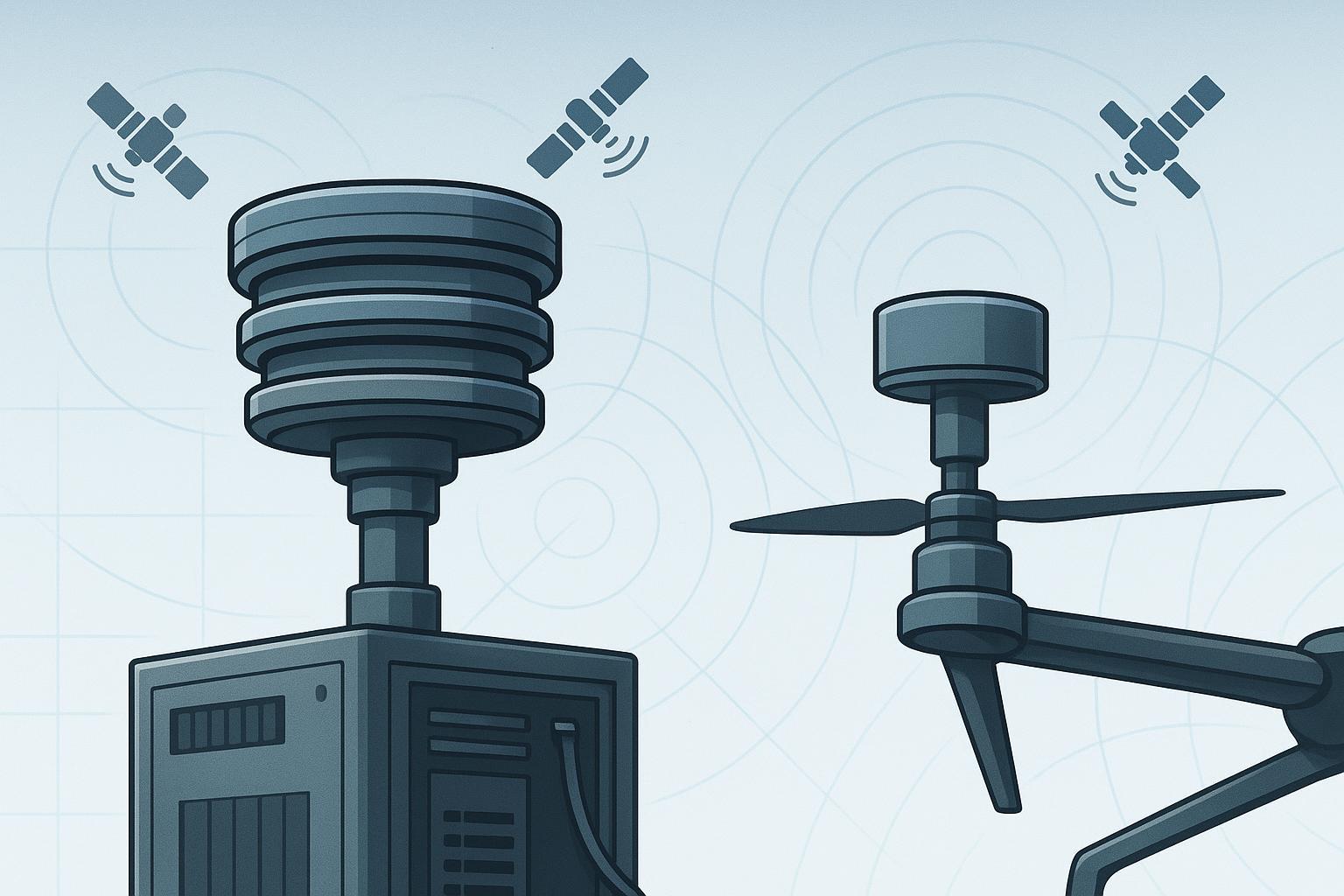
GNSS timing vs positioning antennas is a comparison of application requirements, not two mutually exclusive antenna technologies. Both receive satellite signals, and some hardware can serve either role. The difference lies in the evidence needed: a timing installation must characterize its time-output path, while a positioning installation must validate observations and coordinates under its intended motion and environment.
A survey reference antenna is also a positioning antenna, even though it is fixed. A timing antenna need not be large or use a choke ring. Start with the receiver and task before assigning a product category.
GNSS timing vs positioning antennas: what changes?
| Question | Fixed timing installation | Positioning installation |
|---|---|---|
| Output being accepted | Time or frequency at a defined interface | Coordinates or observations at a defined reference point |
| Delay evidence | Antenna path, cable and receiver compensation | Relevant RF delays and measurement consistency |
| Calibration | Timing-chain characterization; phase corrections where used | Matching carrier-phase corrections where required |
| Mechanical constraints | Stable mount, weather exposure and service access | Mount geometry; mass and attitude for moving platforms |
| System validation | Independent time reference, alarms and recovery | Independent position control, motion and solution transitions |
Both need compatible signal bands, polarization, RF gain, supply and connectors. A stable fixed installation can still suffer multipath and interference; a lightweight moving antenna still needs suitable delay and phase behavior.
Delay and phase-center calibration are related, not identical
Group delay describes frequency-dependent propagation through a defined RF path. For an active antenna assembly, its measurement can involve the element, amplifier and filters. Request reference planes, passband, setup and temperature conditions rather than comparing undefined datasheet numbers.
Phase-center offset and variation describe the effective reception of carrier-phase observations relative to the antenna reference point. NGS’s antenna calibration FAQ explains how the antenna hardware changes the measured carrier phase and why direction-dependent corrections matter. That calibration is not, by itself, the absolute timing delay of the entire receiver chain.
For a fixed timing node, characterize or calibrate the relevant delay path and apply compensation according to the receiver instructions. For a survey workflow, use the supported antenna/radome calibration and the correct height reference. A system performing both tasks may need both forms of evidence.
Patterns and polarization matter in both roles
A timing node on a reflective roof needs suitable reception and multipath performance, just as a rover does. A moving platform adds attitude-dependent visibility and mechanical constraints. Neither situation can be assessed from zenith gain or axial ratio alone.
Ask for patterns over the relevant bands and orientations, with the ground plane and radome identified. A patch and a helix can each perform well when designed and installed for the job. Do not assume either geometry always wins a dynamic RTK comparison.
Check the production enclosure. Conductive structures and cable placement can change the installed antenna behavior. The UAV integration guide discusses airframe constraints, while the timing antenna guide covers the fixed-source measurement chain.
Can one antenna serve both applications?
Yes, if it meets both receiver interfaces and the installation requirements. Evaluate required signals, amplifier gain, bias voltage and current, cable loss, delay evidence, calibration availability and environmental configuration. Passing one application’s test does not establish performance in the other.
Use the GNSource measurement catalog carefully when screening options. Some model figures describe inter-frequency delay, while another may use the label “group delay.” Those labels should not be treated as equivalent without the measurement definitions. Likewise, a listed phase-center error is not proof that an absolute calibration file is available.
For a combined reference and timing project, specify both outputs in the RFQ. For a moving rover, ask whether the proposed hardware and mount fit the platform, rather than paying for a large enclosure because it carries a timing label.
Test each output with an appropriate reference
For timing, use the installed RF path and receiver configuration. Compare output time with an independent reference of suitable uncertainty. Record path compensation, receiver operating mode, warm-up, locked behavior, holdover and reacquisition. Assess the output against the application’s budget.
For positioning, use independent control appropriate to the motion and environment. Log raw observations, correction age, solution state and interruptions. Measure the antenna’s offset to the platform reference point and account for sensor timestamps in fused or mapping systems. A fixed solution indicator is not an independent accuracy check.
A conducted network-analyzer measurement can characterize cables or a front-end path between defined ports. Measuring the radiating antenna requires an appropriate over-the-air reference and fixture treatment. It is incomplete to describe the whole antenna’s delay as a simple two-port sweep without identifying that setup.
Control the comparison
Keep receiver firmware, signals, correction source and cable configuration fixed when comparing antenna samples. If the mount or cable must also change, record those as separate variables. Match observations by relevant sky geometry and operating state.
For interference evaluation, use the platform’s normal transmitter states or a controlled laboratory setup. Do not infer a general blocking or survival rating from one successful trial. Retain the exposure conditions and distinguish temporary tracking loss from permanent degradation.
Pricing should follow the required deliverable. The GNSS antenna cost guide provides a quote-comparison checklist; broad category price ranges are not a reliable substitute for a configuration-specific quotation.
Frequently asked questions
Are timing antennas always more precise? No. Precision needs a defined measurement. Compare time-output error for timing and position or observation quality for positioning.
Does a fixed survey base need a timing antenna? It needs an antenna suited to its observations, calibration requirements and installation. A timing label alone does not establish that suitability.
Can PCV data replace a timing calibration? No. Carrier-phase corrections do not fully characterize cable, front-end and receiver delay.
What belongs in a sample request? Include the receiver, signal list, power, cable, mount and required test evidence. State whether the application accepts time, position or both.
Review model-specific measurement antenna specifications, then send GNSource the two receiver interfaces and validation requirements if you are evaluating one antenna platform for both uses.